Choices
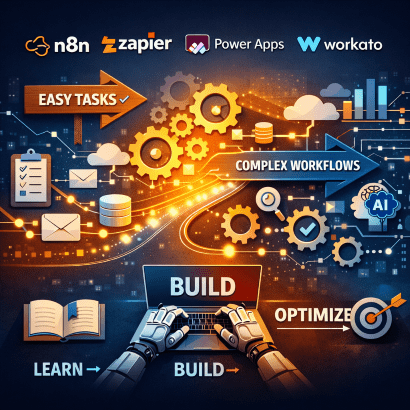
In today’s digital landscape, businesses are surrounded by tools that promise simplicity. Platforms like n8n, Zapier, Microsoft Power Apps, Make, and Workato have transformed what’s possible without deep technical expertise — and that’s only scratching the surface.
There are a lot of tools out there.
On the surface, integration has never been easier.
But there’s an important truth that often gets overlooked:
“easy” depends on what you already know.
The Illusion of Easy
Modern tools are designed to be user-friendly. Drag-and-drop interfaces, prebuilt connectors, and templates make it possible to build working solutions quickly. You can connect your CRM to your email platform, automate reporting, or sync data across systems in a matter of hours.
And in many cases, it really is that simple.
For example:
- Converting data from one format to another
- Sending structured data from one system to another
- Parsing emails and extracting key fields
- Triggering alerts or basic workflows
These are often quick wins.
Correct knowledge is power — and with the right understanding, these tasks can be implemented rapidly and reliably.
Where It Gets Complex
The difficulty increases when:
- Data needs deep transformation or enrichment
- Multiple systems must align perfectly
- Business rules become layered and conditional
- Processes require accuracy, traceability, and scale
This is where a “simple workflow” can evolve into something far more complex — sometimes requiring dozens or even hundreds of transformations to make the data truly usable and fit for purpose.
And this is where the path becomes longer, more considered, and more deliberate.
There’s Always a Better Way (If You Take the Time)
It’s not that people build something and later realise they did it “wrong.”
In reality, experienced professionals approach this differently.
Even experts take time to:
- Research the problem space
- Validate assumptions
- Compare multiple approaches
- Draw on patterns from hundreds of past implementations
The difference is not speed — it’s quality of decision-making.
The goal isn’t just to build something that works.
It’s to choose the most optimal, scalable, and maintainable path from the start.
That doesn’t always happen instantly.
But it does happen deliberately.
How Experts Reduce Risk
One of the key practices in high-quality integration work is iterative testing.
Rather than building everything end-to-end and hoping it works, experts:
- Break the solution into components
- Test each part individually
- Validate assumptions early
- Confirm that systems behave as expected
Because here’s the reality:
There is always a chance that something in your process won’t work — and sometimes that can be a showstopper.
By testing interactively and incrementally:
- You dramatically increase the chance of success
- You identify issues earlier (when they’re easier to fix)
- You uncover optimisation opportunities along the way
It may take longer upfront, but it leads to stronger, more reliable outcomes.
Why It Still Feels Hard
Integration becomes “hard” not because the tools are bad, but because:
- It takes time to build the right understanding
- It requires alignment between systems and business logic
- There are multiple valid ways to solve the same problem
- The “best” solution isn’t always obvious immediately
Even the best in the field don’t always have instant answers.
A good integration specialist will say:
“Here’s what we know — and here’s what we need to validate.”
That’s not hesitation. That’s how robust systems are built.
The Smartest Approach: Learn, Then Engage
The most effective businesses take a balanced approach:
- Do your own research
Explore tools and understand what’s possible. - Build small, practical examples
Even simple workflows teach you how systems behave. - Engage experts when complexity increases
They help guide architecture, avoid pitfalls, and optimise outcomes.
The benefit?
👉 You understand your own requirements better
👉 You ask more informed, targeted questions
👉 You become part of the solution, not just the recipient
Where AI Fits In
At xbots, we work at the intersection of data integration, automation, and AI.
And we’re very clear about this:
AI is a tool — a powerful and diverse one — but not without its flaws.
AI can:
- Accelerate development
- Suggest patterns and solutions
- Help prototype workflows quickly
But it also:
- Can misunderstand context
- Requires validation
- Needs to be aligned with real-world processes
The real value comes from using AI within well-designed systems, not relying on it blindly.
Build, Don’t Just Buy
If you want to truly understand integration, there’s one approach that consistently works:
Plan for it. Pick a technology. Build it.
At xbots, we run hands-on build sessions where we:
- Take a real-world problem
- Break it down step by step
- Build the solution together
You don’t just learn theory — you experience the process.
And that’s where the real understanding comes from.
Final Thought
Integration today is both easier and more demanding than ever.
- Easier, because the tools are accessible and capable
- More demanding, because doing it well requires thought, testing, and experience
The goal isn’t just to connect systems.
It’s to design solutions that are:
- Efficient
- Robust
- Scalable
- And aligned with how your business actually works
Because when everything connects the right way…
That’s when the real value shows.